


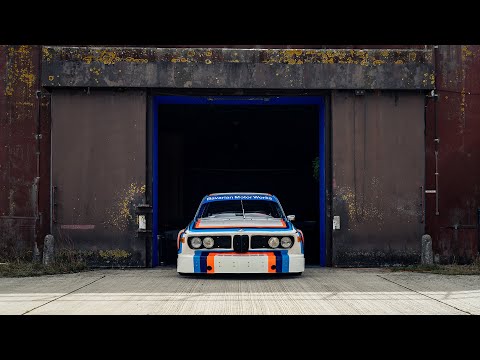
The 1970s were a strange time. People wore pants they couldn't walk in, people smoked on airplanes, and car safety was a passing thought, somewhere between choosing the color of an ashtray and the type of leather. But it was in this chaos that BMW's Bob Lutz said, "Enough is enough," and started a factory racing team. The result? The machine you're looking at. This isn't just any old BMW. This is Genesis. This is "Patient Zero." The first M-badged car to ever hit the road. And now it can be yours. BMW 3.0 CSL Werks
If you thought today's big kidney-shaped BMWs were controversial, let's go back to 1972. BMW was a brand for serious gentlemen in hats until they decided to show the world their middle finger and create something brutal. Chassis E9/R1 - remember that code because it's more important than your tax return - was the first child of the newly formed BMW Motorsport division. 1972 BMW 3.0 CSL Werks
Built in the winter of 1972/73, the 1972 BMW 3.0 CSL Werks served as a laboratory on wheels. It was the testing ground for what we now know as the legendary “Batmobile” aerodynamic package. Yes, those huge wings and spoilers, which look like they were stolen from a Cessna, weren’t there for decoration. They were there to keep this thing from flying into the Bavarian sky at 250 km/h.

The Heart of the Monster: Numbers That Still Frighten Today
There's no hybrid system or battery pack that weighs as much as a small church under the hood. No. There's pure, mechanical poetry. Although it started out as a 3.0 CSL, this specific model is equipped with a massive 3.5-liter inline-six.
We're talking power in excess of 298 kW (400 hp). Yes, you read that right. Four hundred horses in a 1972 car that probably weighs less than your morning coffee. That means a power-to-weight ratio that modern safety inspectors would call "attempted murder." So let's take a look: 1972 BMW 3.0 CSL Werks
- Engine: 3.5-liter inline six-cylinder
- Power: > 298 kW (> 400 hp)
- Transmission: Manual (of course, what else?)
- Drive: Rear (where it should be)
- Acceleration? There are no official figures from the time, because they were too busy holding the steering wheel to not die. But judging by the specifications, we can conclude that this thing accelerates to 100 km/h (62 mph) in the time it takes to say “Mein Gott”. And the top speed is certainly in excess of 280 km/h (174 mph), which in a car without ABS, ESP and airbags is an experience that separates children from men.

History soaked in gasoline
This car wasn’t just sitting in a garage collecting dust. It was a working machine. It was the first of 21 Werks CSL cars and one of 11 that the factory team actually raced on the track. In 1973, BMW Motorsport sold it to an American team for the 1974 IMSA championship. Imagine the culture clash – precision German engineering amidst American muscle cars in the 1970s.
After retirement, the E9/R1 spent decades in private collections, hidden from public view like some lost Da Vinci painting. In the last decade, it has undergone a restoration process by a BMW specialist, where the aim was to preserve its originality. That means not replacing every bolt with a shiny new one, but preserving the soul of the car.
“This is not a car for those who are concerned about fuel economy or smartphone connectivity. This is a car for those who understand that driving is a conversation between man and machine.”

Why is this important today?
BMW recently released a limited edition of the new 3.0 CSL – only 50 were made, with a power of 412 kW (553 hp). Are they fast? Absolutely. Are they technologically advanced? Without a doubt. Are they the first? No.
This car, sold by Dylan Miles, is an original. It was presented at Goodwood Festival of Speed 2021 and finally at the Salon Prive Concours D'Elegance in August 2025. It's your ticket to the most prestigious events in the world. With it, you don't just get to the show; with it, you're the star of the show.

Conclusion: The Price of History
You're probably wondering about the price. The ad says what we all hate and respect at the same time: “Price on Application.” This translates to: “If you have to ask, you can’t afford it.” And you’re probably right. We’re talking millions.
But look at it this way. You can buy a yacht that will lose value the moment you launch it. You can buy penthouses in Dubai that have no soul. Or you can buy a BMW 3.0 CSL E9/R1. You can buy the bones and muscles that built the entire mythology of the letter M. You can buy the smell of burnt oil, the sleepless nights of engineers and that pure, unfiltered fear when you realize at 200 km/h that traction is just a theoretical concept.
This isn't just buying a car. This is adopting a T-Rex. And let's face it, who doesn't want a dinosaur in their garage?