


Admit it, we were all a little scared. We were afraid that Lotus had become just another brand that produced heavy electric SUVs for people who thought that "dynamic driving" was accelerating to the next traffic light in the shopping mall. We thought that the spirit of Colin Chapman - that brilliant and obsessive engineer who shouted "simplify and add lightness" - had finally disappeared under the weight of lithium-ion batteries. But we were wrong. Oh, how wrong we were. Here we have the Lotus Theory 1. And it's not just a car. It's proof that physics still holds true and that the future doesn't have to be boring.
Let's get one thing straight first. It's called Lotus Theory 1 (Theory 1). The name sounds like the title of a boring PhD thesis on quantum mechanics, but it’s actually the most exciting thing to come out of Hethel (or more accurately, their global studio) since they figured out they could cram a Honda engine into an Elise. It’s a concept that screams, “We can still do it!”
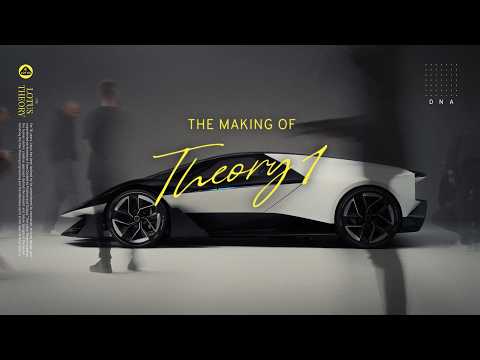
In a world where electric supercars weigh as much as a small church, Lotus has pulled off a miracle. The target weight of this car is less than 1600 kg (3527 lbs). For a gasoline car, that would be “okay,” but for an all-wheel drive electric car with 1000 horsepower, it’s almost magic. For comparison: the Lotus Eletre, their SUV, weighs about as much as two Theory 1s and half a Miata.


Numbers that confuse the mind
Let's look at the "dry" statistics, which are anything but dry. The powertrain develops a brutal 735 kW (987 hp). That means this thing can rocket from a standstill to 100 km/h (62 mph) in less than 2.5 seconds. That's faster than it takes to read this sentence. Top speed? 320 km/h (199 mph).
But with electric cars, we always ask ourselves: “How long will the fun last?” Lotus has installed a 70 kWh battery. That may sound small compared to 100+ kWh monsters, but remember – lightness. A smaller battery means less weight, less weight means better dynamics. And yet they promise a range of 402 km (250 miles) according to the WLTP standard. Enough to scare two passengers and still get home.

Seating order: Me, me and… two more in the back
This is where things get really interesting and nostalgic. The Theory 1 has three seats. The driver sits in the middle. Yes, just like in the legendary McLaren F1. It’s not just the “cool” factor, it’s the only right way to drive. You’re the center of the universe, the ruler of the road, the captain of your spaceship. And on each side, slightly set back, are two passenger seats. Perfect for two friends to drive, sharing the fear in their eyes as you step on the gas pedal.
The doors? They don't open outwards, nor upwards like a Lamborghini. They open backwards and upwards in a complicated pirouette that allows you to get into the car even in a tight parking space without doing yoga.

The car that “sends” you – Lotuswear™
And now for the most bizarre, yet ingenious part. Lotus has developed something they call Lotuswear. Forget leather and plastic. The interior is clad in a “robotic textile” developed in collaboration with MotorSkins.
It's not just fabric. It's a living thing. There are little inflatable bubbles in the seats and steering wheel that give you haptic feedback. If an obstacle is approaching from the right, the seat will gently nudge you in the right side of your ribs. Instead of beeping like a microwave, the car talks to you through touch. Imagine a car tapping you on the shoulder and saying, "Hey, watch out, corner." It sounds strange, but in a world overloaded with screens, this might be the solution we've been waiting for. Buttons? None. When you need them, they "inflate" out of the fabric. When you don't, they disappear. Pure magic.


The Challenge of 10
There are hundreds of different materials used in a modern car. Lotus said, “Nonsense.” For the Theory 1, they set a goal of using only 10 main materials on visible surfaces. Recycled carbon fiber, cellulose composites, recycled glass… It’s the philosophy of minimalism on steroids.
The engine and battery are not just a load, they are part of the stressed member, just like in the old Lotus 49. The rear suspension is attached directly to the engine/battery housing. This is not just engineering; it is the art of stripping away all that is superfluous until only pure function remains.


Conclusion: Is this the savior of the soul of motoring?
The Lotus Theory 1 is, to be honest, a concept. You probably won't see it in showrooms in exactly this form next year. But it's important. It's important because it shows that the electric future doesn't have to be fat and silent. It shows that it's possible to make an electric car that doesn't weigh as much as a small moon.
If Lotus can manage to transfer just 50 %s of this philosophy into a production car – this lightness, this driver-centricity, this crazy idea that the car is an extension of your body and not just an iPad on wheels – then we have hope.

The price? This is not mentioned in the concepts, but if it were to be built, it would probably cost as much as a small island. But it doesn't matter. What is important is that Lotus (and their owners at Geely) have proven that they haven't forgotten what it means to drive. That driving is not just about getting from point A to point B, but about the feeling when the hairs on your arms stand on end. And in Lotus Theory 1 These hairs warn you about the bend.
Well done, Lotus. Now, please, make this. And don't change anything. Not even those strange seats.

