


It's finally here - the Samsung Galaxy Z TriFold. After months of rumors that were more unreliable than the weather forecast in April and concepts that looked like props from a Star Trek movie, Samsung has thrown its cards on the table. And not just any cards - they threw the entire deck. They've unveiled the Galaxy Z TriFold, their first tri-folding beast. Is this the engineering marvel we've been waiting for, or just a panicked response to Chinese dominance? Buckle up, we're in for a ride.
If you've been following the smartphone world for the past few years, you've probably noticed that it's gotten a little boring. They're all rectangular, they're all glass, and they're all overpriced. Samsung was the first to seriously take a stab at foldable phones, but honestly, the last few generations of the Fold have been more like a facelift of the same car than a revolution. While Huawei, with its Mate XT flexing their muscles and bragging about how they could fold their phone into three parts, Samsung sat quietly in a corner, polishing its hinges. And so it was – Samsung Galaxy Z TriFold.
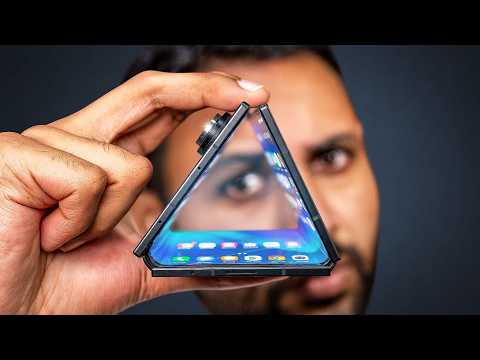
Well, the silence is over. Galaxy Z TriFold is here, and it brings a philosophy that any engineer who values longevity over lipstick would approve of. Unlike Huawei, which risks its screen on the outside like some kind of exhibitionist, Samsung has taken a “gatefold” approach. Two sides close inwards. When closed, your precious 10-inch real estate is as safe as money in a Swiss bank.
Screen: Big enough to park a bus on
When you open this thing, you're not looking at your phone anymore. You're looking at a 10-inch (25.4 cm) screen. We're talking a native resolution of 2,160 x 1,584 pixels. That's more pixels than your first TV had. With a variable refresh rate of 1 to 120 Hz and a peak brightness of 1,600 nits, this display is ready for anything—from checking your email on the beach to watching Netflix in bed when you should be sleeping.

But Samsung hasn't forgotten about the exterior. On the back (when the device is closed) you'll find a 6.5-inch (16.51 cm) display with a resolution of 2,520 x 1,080 pixels and a 21:9 aspect ratio. Here, they've gone one step further with the brightness – 2,600 nits. That's so bright that you'll probably need sunglasses if you're checking your watch at night. It's protected by Corning Gorilla Glass Ceramic 2, which translates to: "Please don't throw me on the floor, but if you do, I'll probably survive."
Engine under the hood: Old school or proven classic?
This is where things get interesting, and maybe even a little controversial. Under the hood, Samsung didn't install the latest technology, the Snapdragon 8 Elite Gen 5, that everyone is whispering about. Instead, they played the reliability card and installed the Qualcomm Snapdragon 8 Elite for Galaxy. This is the chip we know from the Z Fold7 model.
Some will say, “Hey, I want a Formula 1 engine for that money!” But look at it this way: it’s like putting a proven V8 engine in place of an experimental hybrid that can be ignited. This processor is a beast. Period. Coupled with 16GB of RAM and up to 1TB (terabyte) of storage, this phone will chew through anything you throw at it and beg for more.

Productivity: An office in your pocket (literally) Samsung Galaxy Z TriFold
This is where the Samsung Galaxy Z TriFold stops being a phone and becomes a tool. Samsung has finally, and I mean finally, enabled Samsung DeX right on the device's screen. No more need for an external monitor. You unfold the phone, connect a Bluetooth keyboard and mouse, and you have a desktop computer. Thanks to the huge screen, you can run three full-size apps at once in portrait mode. This is no longer "multitasking," this is digital juggling on steroids.

Energy and stamina
Powering three screens is no easy feat. Samsung solved the engineering problem by splitting the battery into three parts and distributing them throughout the body. Total capacity? 5,600 mAh. That's a respectable number. It supports 45 W (watts) wired charging and 15 W wireless. It's not the fastest on the market (the Chinese still lead here), but Samsung is clearly still having nightmares about the Note 7 and prefers to play it safe.
Cameras: No more compromises
Usually, foldable phones have lagged behind their classic brothers in terms of cameras. Not here. The main camera has 200 MP (megapixels) with an ISOCELL HP2 sensor. This is a sensor that captures so much detail that you will see wrinkles in your photos that you didn't know you had. It is accompanied by a 10 MP telephoto camera with 3x optical zoom and a 12 MP ultra-wide-angle camera. This is a system carried over straight from their best line.
What about the internet?
The internet is, as always, divided into two camps: those who are excited and those who are already writing obituaries to their bank accounts. The initial reactions on YouTube and tech forums are a mix of awe and cynicism. Users are excited about the DeX mode directly on the device, as it finally justifies the existence of foldable phones. “Finally a tablet that fits in your pocket,” reads one popular comment. On the other hand, the criticism is relentless regarding the thickness and weight. Many make fun of the two folds on the screen: “Now I can have two valleys instead of one!” The biggest fear? Durability. Stories about the soft internal screen that scratches even when you look at it are circulating faster than a virus. And of course, the price. Although the official price for the US has not yet been confirmed, calculations from Korean prices are around $ 3,000 (approx. EUR 2,800), which has triggered an avalanche of comments like: “I’ll buy a used car and an iPhone for this money.”
Below the line_ A toy for the gods?
The Samsung Galaxy Z TriFold comes in an exclusive Crafted Black color. Sales start in South Korea on December 12th, followed by the US and select Asian markets. Europe is currently silent, which is typical.
Is this a phone for everyone? Of course not. It's the technological equivalent of a supercar. It's impractically expensive (though prices haven't been officially confirmed yet, so expect it to hurt), probably heavier than your wallet, and full of mechanics that can break. But it's also a device that restores our faith in innovation.
In a world of boring rectangles, Samsung has finally done something that makes us stop and say, “Okay, this is cool.” And sometimes that’s all that matters. If you have the money and big enough pockets (literally and figuratively), this is the only device you’ll want this year.

