


For twenty years, we've been sticking GoPros to helmets, skis, motorcycle handlebars, and—let's face it—things we'd rather not mention here. Now, the little adventurer has put on his pants, put on his jacket, and stood in front of the mirror. The GoPro Mission 1 is no longer a camera. It's a declaration of war.
I know what you're thinking. Another one GoPro a camera that will end up in a box with old iPhone 6 cables after six months. I admit, I thought the same thing when I first heard the name “GoPro Mission 1.” It sounded like a spy series that I would Netflix canceled after the first season.
But then the first hands-on reviews started to come in. DC Rainmaker, one of the most meticulous sports technology testers on the planet, wrote something after two weeks of testing that is practically unheard of coming from his mouth: "The recording is really, really, really good." Three “really” in a row. The man who usually starts with “here are 47 problems with the new wearable” listed 50 new features and asked for other superlatives.
That means something. Most importantly, it means that GoPro has finally bitten off something it can chew.
Three brothers, one heart, a million possibilities
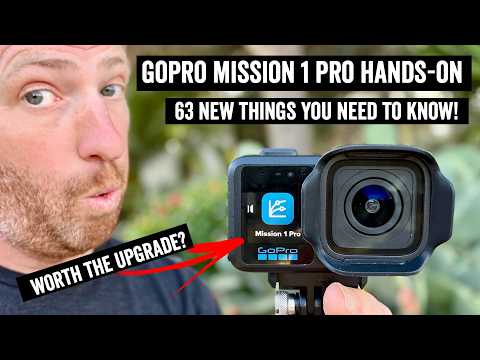
Series GoPro Mission 1 is coming to three formswho share the same heart: fresh 50-megapixel 1-inch quad-bayer sensor and brand new GP3 processor. GP3 is the brain that enables higher frame rates, higher bit rates and that thermal stability that is crucial in such a small box. The sensor is now larger than anything the competition is driving – that's not all, but it's a solid starting advantage.
Mission 1 (basic, $599 / ~560 EUR) records 8K at 30fps, 4K at 120fps in Open Gate and 1080p at 240fps.
Mission 1 Pro ($699 / ~650 EUR) and pushes the gas all the way: 8K at 60fps, 4K at 240 fps without any time limits (so far we have been limited to 4K 120 with action cameras), 1080p at 480fps unlimited and – watch out now – 1080p at 960 fps in burst mode for up to 10 seconds. That's 32 times slower. If you could film a fly sneezing, you could write a doctoral dissertation on it.
Mission 1 Pro ILS (also $699, available in Q3 2026) is the camera that makes Panasonic now hold a cup of coffee a little more forcefully in the office.
Mission 1 Pro ILS: the camera that forgot it was a GoPro

Here we come to the kid everyone will want to meet at the party.
Mission 1 Pro ILS is the first GoPro with interchangeable lenses. It uses Micro Four Thirds mount – same as Panasonic GH series and OM System. This means access to over 300 compatible lenses, plus endless possibilities with adapters. Macro lens? They have it. 200mm telephoto lens? Come on. Anamorphic lenses for a filmic “look”? They’ll make you tea in the meantime.
Even crazier: HyperSmooth stabilization works with all rectilinear prime lensesSo GoPro has taken its most iconic technology—electronic stabilization, which changed the game a decade ago—and pushed it into an interchangeable lens system. Most mirrorless cameras simply can't do that.
Body measurements 89.6 x 58.7 x 46.1 mm (less than 20mm wider than the Hero13 Black). Where the Canon needs a backpack, the GoPro needs a slightly larger pocket.
But – and here's an ironic detail I have to tell you – the camera does not have autofocus. Res. Mission 1 Pro ILS is only manually. In the world of film cameras, this is completely normal; professional operators use follow-focus anyway. In the world of “GoPro turn on and shoot,” this is exotic. But it’s also the reason why the camera costs $699 and not $1,999. There’s also no electronic contact with the lens – it’s a purely mechanical attachment. The lens is a lens, the camera is a camera, there’s metal in between.
Sensor and processor: the magic happens in the background
Nov 50-megapixel 1-inch sensor has 1.6 μm pixels at full resolution and 3.2 μm in quad-bayer mode at 4K. This is technical jargon for: The camera now sees things in the dark that GoPro has never seen before.
It brings with it 14 stops of dynamic range, new 10-bit GP-Log 2 color curve (warning: not interchangeable with the old GP-Log on the Hero 13 Black) and RAW photos at 50 MP in burst mode up to 60 frames per second. The bit rate has jumped to 240Mbps, with an additional 300 Mbps available through GoPro Labs.
And then there's the new one dedicated night mode for 4K 60. DC Rainmaker was more reserved about it because he's not allowed to show footage during the embargo, but he describes the difference compared to the Hero 13 Black as brutal: the old Hero shows a completely black scene in the same darkness, while the Mission 1 delivers a usable image. GoPro has struggled with low light for a decade. It seems they've finally found the recipe.
Sound that's finally not an afterthought
If there was one thing that GoPro has messed up badly throughout history, it was the sound. It felt like you were filming in a washing machine.
Now everyone has Mission 1 four microphones with 32-bit float recording, stereo sound and wind reduction. A microphone has been added on the back – specifically for cases when you are talking into the camera. Two microphones are on the front and ensure true stereo.
Important: that hole on the side that users have been forcing open for years, there is no door. That is microphone drainage. The door is somewhere else. If you try to open it, you will kill the camera. A small warning from the experiences of people who have already bought a new GoPro for a friend.
Connectivity with Bluetooth 5.3 It also allows you to play recorded audio and system beeps directly in the headphones. Each generic USB-C microphone now works – without the idiotic adapters they previously required. Plus, it comes GoPro's own wireless microphone system for 160 USD (~150 EUR), making GoPro quite clearly aiming at Rode and DJI.
Endurance: why GoPro even exists
Something hasn't changed, and thank God.
Mission 1 and Mission 1 Pro are waterproof up to 20 meters (66 ft) without an additional housing – an increase from the previous ten. With a dedicated diving housing up to 60 meters (196 ft)The ILS version is only weatherproof; it needs a waterproof case, like any other camera with a bayonet mount.
Here is one of those too small engineering gems, which makes me love GoPro: "equilibrium" buttons. Water can pass under them. Why? Because when diving deeper, the buttons get stuck under the pressure of the water. The Mission 1 doesn't. It's the kind of detail that tells you that someone in the office has been listening carefully to what the divers have to say after ten years.
Two night functions have been added: diving mode, which automatically corrects colors at depth (without the need for filters), and Sports POV mode, which uses a gyroscope and accelerometer to stabilize during sharp turns. For motorcyclists, racers, and cyclists, this is a blessing.
Front: lens hood, which you can take off. DC Rainmaker honestly admits that he will probably lose it sooner or later. Fair statement.
Enduro 2 battery: a true game changer
New battery Enduro 2 has 2,150mAh (old 1,900 mAh), which is larger than any competing action camera. Compatible with Hero 13 Black – if you have older batteries, they will work in Mission 1, just with a slightly shorter autonomy.

And the real miracle is charging speed: from 0 to 80 % in 20 minutes. Realistically. DC Rainmaker came in at five hours in 1080p during the test (officially 5 hours 15 minutes with GPS turned off, but he didn't turn it off), and in 8K 30 instead of the promised 96 minutes he got 85 minutes in 16:9 portrait mode. So the battery is as close to the promise as it gets in this business. For comparison: the DJI Action 6 is noticeably faster at the end of the day with the same loads.
Tiny details that are much more than tiny
- 2.59-inch OLED display behind – 14 % larger from the previous one. Raised buttons for use with gloves.
- Ambient light sensor on the front (that white dot that most people don't notice) automatically detects the frequency of light and adjusts the anti-flicker settings. If you're used to shooting in 60 Hz America and you travel to Europe with 50 Hz lights, the camera will warn you and correct you. A little gem for travelers.
- Subject tracking – the camera now automatically follows you (electronically, of course, not mechanically).
- 2x, 3x and 4x digital zoom, which crops from an 8K sensor without losing quality at 4K.
- Cinematic color mode (like a color filter that is irradiated into the file).
- Image tuning presets: bounce, sport, face, underwater.
- ISO and shutter range, which you can set instead of manual values.
- New recording modes, which you can now turn on/off as needed.
- Open Gate mode – which GoPro has supported for three generations, but has now simply named it so that people will finally understand that they have it.
What was removed: 2.7K and 5.3K resolutions (the new sensor does not support this), 8:7 ratio (replaced by 4:3), and – this is painful – old HP serial lenses with Hero 13 Black (macro, anamorphic) they don't physically fit because the new sensor is too big.
A little history lesson
GoPro was founded in 2002 Nicholas Woodman as a one-man company out of the idea that surfers could film themselves in the waves. The first models used 35mm film and looked like something a child would have put together from a playset.
Twenty years later, GoPro sells a $699 camera that rivals DSLRs for thousands. Woodman himself recently said that they pro-oriented customers have been asking for the same camera for yearsAfter years of incremental Hero improvements (11, 12, 13 were more evolution than revolution) this is the first truly bold leap.
Competition: who should prepare for a hard blow?
Realistically: for $699 you get the Mission 1 Pro. For the same money you can buy the Canon EOS R50V or Nikon Z30 – solid APS-C vlog cameras. But GoPro has three aces that can't be beaten: water resistance up to 20 meters without a case, HyperSmooth, which remains best in class, and 1080p at 960fps.
DJI Osmo Pocket 3, Insta360 Ace Pro 2 and DJI Action 6 – all are now in a position to respond. It won't be easy. The Insta360 still has some interesting features (uploading to a local NAS or Google Drive) that the GoPro unfortunately doesn't yet have. There's also no built-in internal storage in case you forget your SD card. These are two little things that GoPro could add with an update, but they're missing for now.
Conclusion: the most expensive GoPro ever, but also the most ambitious
Let me be honest: the Mission 1 is not for everyone. If you ski once a year and want to film your descent on Krvavec, the Hero13 Black is still the right choice. The Mission 1 is a camera for those who they use the camera as a tool, not a toy – for documentarians, automotive journalists, Mr. Beast production crews, filmmakers who need a second camera and not half a roof behind it.
It is also the most expensive GoPro in history – Mission 1 at $599 (~€560), Mission 1 Pro at $699 (~€650), For ILS also $699, but not until Q3 2026 (by all indications closer to September than July). $100 off for existing GoPro subscribers. Mission 1 and Mission 1 Pro they go on sale May 28, 2026, pre-orders are open.
And here's the point: GoPro just did something no other DSLR manufacturer has managed to do – in a single body smaller than most cheap compacts, it squeezed 8K, 14 stops of dynamic range, interchangeable MFT system, waterproof to 20 meters, professional sound, 32-bit float, subject tracking, 240 Mbps bit rate and a battery for a whole day of shooting. No autofocus, no internal memory, no synchronization to a local NAS. Really. But with imagination that the camera industry hasn't seen since the day Olympus introduced the first OM.
When DC Rainmaker—a man whose day starts by listing the errors in his GPS watches—says “this footage is really, really, really good” three times in a row, something is happening. Mission 1 isn’t just a new GoPro. It’s a declaration that action just moved from adrenaline-fueled YouTube channels to professional film rigs.
And I don't know about you, but I can't wait to strap it to the nose of a race car, look at the result, and laugh out loud. Because if there's one thing GoPro has always done better than anyone, it's the ability to show us the world from angles we never even dared to imagine before. Mission 1 now does just that—only with much, much better lenses.
